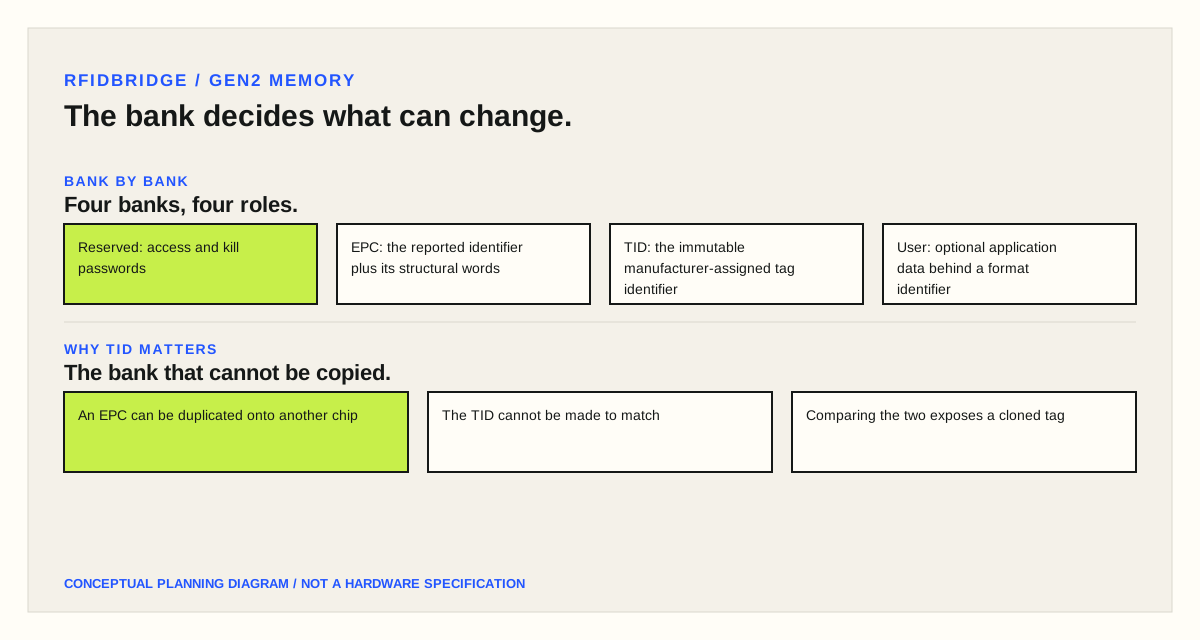
Gen2 organises tag memory into reserved, EPC, TID and user banks. The bank decides whether a value can be changed, who assigned it, and whether it survives the point of sale.
01 / FIELD NOTE
Keep the decision tied to the operating context.
The standard behind most UHF supply-chain RFID is formally the EPC Radio-Frequency Identity Protocols Class 1 Generation 2 UHF RFID protocol for communications at 860–960 MHz. It was developed by EPCglobal, which is now GS1, and was approved as ISO 18000-6C. It defines the air interface for tags in that band and allows different frequencies to be used in different regions within it, which is why one protocol covers installations with different regional channel plans.
Gen2 tags carry four banks of non-volatile memory. Each is accessed in 16-bit units called words, addressed from word zero, and each has a distinct role that determines how an application should use it.
Reserved memory, bank 0, holds the two security passwords. The kill password is 32 bits and permanently silences the tag; the command only takes effect once the password has been set to a non-zero value, because the default is zero. The access password is also 32 bits, and accepting it moves a tag into a secured state in which it will execute access commands, including writing to locked memory blocks. Both passwords have to be accepted before the corresponding operations proceed, which is what makes them a control rather than a suggestion.
EPC memory, bank 1, holds the Electronic Product Code and the structural fields around it. A CRC-16 error-detection code allows the reader to check that the value it received is intact. A protocol control word describes the EPC that follows: its length, and whether the tag has user memory at all, whether an extended protocol control word is present, and whether the data uses a GS1 coding scheme or an ISO/IEC 15961 one. The EPC itself starts at word two and runs from 96 bits upward, so a system that writes EPC memory is also responsible for setting the protocol control word consistently.
TID memory, bank 2, holds the tag identifier assigned by the chip manufacturer. It cannot be changed or erased, and it identifies the tag rather than the object. That immutability is what makes it useful for authenticity checks and for detecting copied tags: a cloned EPC can be duplicated onto another chip, but the TID cannot be made to match, so comparing the two exposes the clone.
User memory, bank 3, is optional and varies in size from around 512 bits up to several kilobytes depending on the chip. It holds data that does not belong in the EPC — temperature or maintenance logs, expiry dates, and application-specific fields. Its initial bits form a data storage format identifier, as specified in ISO 15961 and 15962, which tells the reading system how to interpret what follows. A system writing to user memory has to write that identifier consistently, or the data it stores is present but unreadable.
Beyond memory, the Gen2 feature set includes global regulatory compliance across regions, memory access control through the access password, memory locking, dense-reader operation, anti-collision that adapts to the environment, a kill function for permanent deactivation, bit-masked filtering that lets a reader select tags by matching part of their data, and cryptographic authentication on later versions for anti-counterfeiting along with functions for untraceability. Read rates above a thousand tags per second are achievable in good conditions; write rates are far lower, on the order of a few tags per second.
That read-write asymmetry is the most consequential fact for system design. Encoding tags during label production, where each tag passes an encoder individually at a controlled rate, is fast and verifiable. Writing to tags on a moving pallet in a live zone is neither, and a failed write is silent — the tag simply carries the old value. Where the identifier is known before application, encode first. Where it is generated at the point of use, budget the time for the write and verify the result by reading it back.
02 / BANK BY BANK
Four banks, four roles.
- Reserved: access and kill passwords
- EPC: the reported identifier plus its structural words
- TID: the immutable manufacturer-assigned tag identifier
- User: optional application data behind a format identifier
03 / WHY TID MATTERS
The bank that cannot be copied.
- An EPC can be duplicated onto another chip
- The TID cannot be made to match
- Comparing the two exposes a cloned tag
Bring the item, material, movement, target read and system context to a sample or project review.
Request a sample test