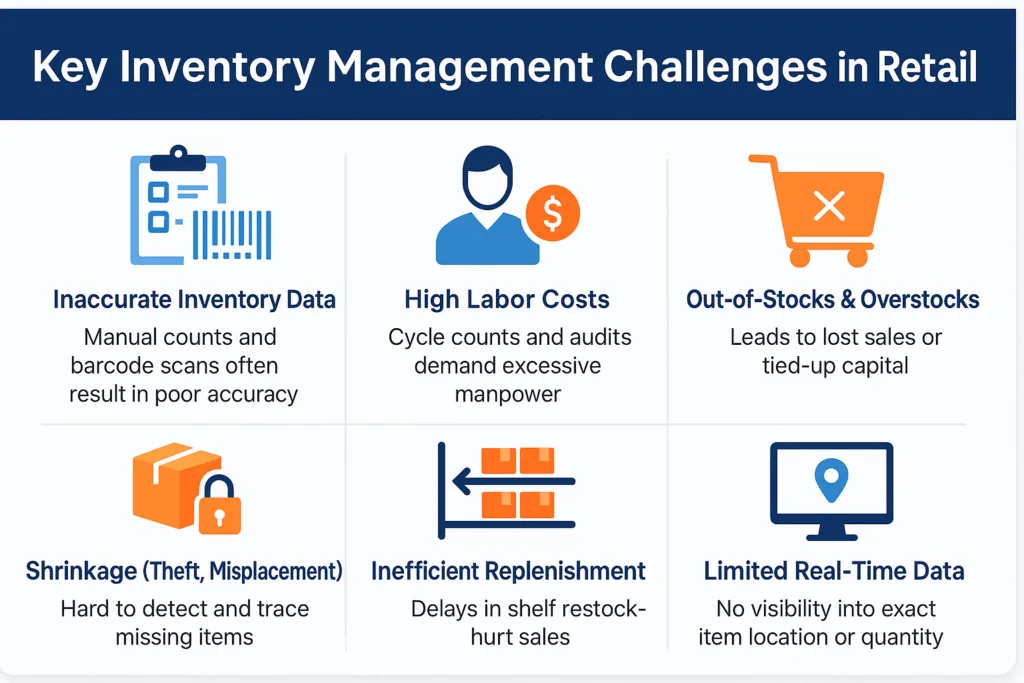
A retail record exists to answer a small set of questions — what can be sold, where it is, what to reorder, and what went missing. Designing for those questions is more useful than designing for accuracy in general.
01 / FIELD NOTE
Keep the decision tied to the operating context.
Accuracy is the property a retail inventory record is usually described by, and it is not what the business wants. The business wants to know what it can sell, where an item is, what to reorder, and what has gone missing. Accuracy is how well those questions can be answered, and treating it as the goal tends to produce a number that is defended rather than a set of decisions that improve.
The first question is availability, and it is more demanding than presence. A garment on a rail is present. Whether it can be sold depends on whether it is reserved for an online order, held for a collection order, awaiting a quality decision, or part of a display that cannot be broken. A record that holds only presence reports availability that does not exist, and the failure surfaces at the moment a buyer is told an item is there.
The second is location, at a resolution that matches how staff work. "In the store" is enough to answer a shopper asking whether the shop has one. "In the stockroom or on the floor" is what a sales assistant needs to decide whether to go and look. Item-level identity connects the two, and the resolution worth keeping is the one that changes what somebody does next.
The third is replenishment, which is where the record earns its cost. Reordering against an inaccurate figure means buying to cover an error, and the error becomes physical stock — a record problem converted into a working-capital problem. The reverse also holds: stock present but recorded as absent triggers a reorder that was not needed, and both directions of error push stock levels up over time.
The fourth is loss, and it needs to be split before it can be managed. A garment on the wrong rail is misplacement, which is fixed in the back room. One received in a short quantity is a supplier discrepancy, which is fixed at goods-in. One that left without payment is shrink, which is a security matter. A count that reports a single variance cannot tell them apart, and the two largest categories require no security response at all.
Item-level identity is what makes these questions answerable rather than merely reportable. A quantity per product code can say how many of a style are held; it cannot say which units, where each one is, or what happened to a particular one. The questions above are all about specific things, which is why a quantity record answers them approximately and a unit record answers them exactly.
The frequency of counting sets how current the answers are, and it is the variable most worth optimising. A record maintained by a count that happens twice a year describes a position that has already changed by the time anyone reads it. Frequent counting of small areas fits into a trading day and corrects drift while it is small enough to trace, which is the practical argument for a continuous rhythm over a thorough one.
Returns are the flow that most reliably corrupts the record, because the item and the money move at different speeds and through different processes. A returned garment is physically present and commercially unavailable, and a record that credits it as available at the moment of return overstates sellable stock for as long as the parcel is in transit back. A record that never credits it loses sellable stock off the books instead.
The channels multiply the problem. A business selling through a shop, a website and a marketplace is running one stock pool against several records, and the lag between them is the mechanism by which the same unit is sold twice. Reducing that lag removes a class of error that no improvement in counting can address, which is why synchronisation is a prerequisite rather than a refinement.
What staff do with the record determines whether it survives. If the sales floor uses it in front of shoppers — checking another store, reserving an item, arranging a transfer — then an error becomes visible quickly and gets corrected. If staff have learned to distrust it and walk to the stockroom instead, the record is maintained for reporting and the operation runs on something else. That is the strongest available signal about whether a deployment worked.
The physical limits are real and worth measuring in the store rather than assuming. Dense rails of garments read differently from folded stacks, fixtures and fittings shield, and metallic trims and security tags change how an individual item responds. A method validated in a demonstration room and deployed into a shop will find the shop’s geometry, and a measurement taken on site is what establishes the read rate the count can actually rely on.
The measure worth keeping is not the accuracy figure but whether the questions get answered. How often an order cannot be fulfilled from stock the record said was there, how long a channel takes to learn about a movement in another, how much stock is present but unavailable, and how many returns await disposition. Those move before a buyer notices, and unlike an accuracy percentage they point at what to change.
02 / THE FOUR QUESTIONS
What the record is actually for.
- What can be sold — availability, not presence
- Where it is, at the resolution that changes what someone does
- What to reorder, so purchasing is not buying to cover an error
- What went missing, split into misplacement, receiving error and shrink
03 / WHAT DECIDES THE ANSWERS
Frequency, synchronisation, and use.
- Frequent counts of small areas rather than rare full ones
- Channel lag removed, so one unit cannot be sold twice
- Returns given a state rather than a status
- Staff using the figure in front of a buyer, or quietly working around it
Bring the item, material, movement, target read and system context to a sample or project review.
Request a sample test