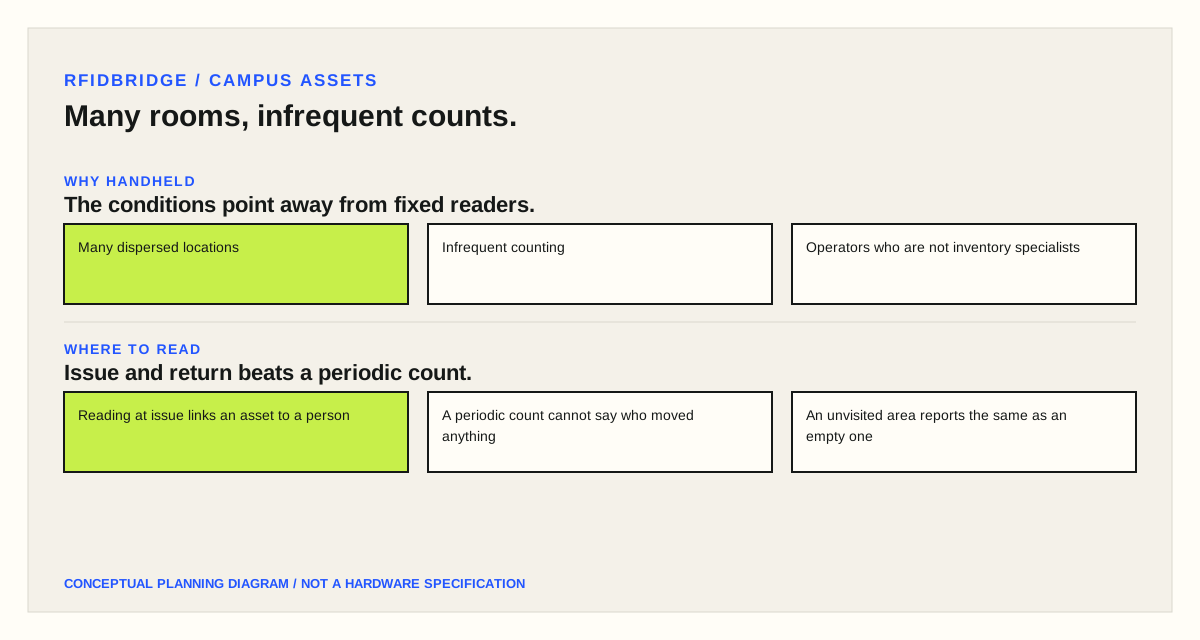
Educational asset tracking is defined by many rooms, movable items and infrequent counts — conditions that favour handheld reading and a location record over fixed infrastructure.
01 / FIELD NOTE
Keep the decision tied to the operating context.
A school or campus holds equipment that moves constantly between rooms that are not under one person's control. Instruments, computing equipment, laboratory apparatus and portable devices are used in one place and stored in another, and the record of where they are is only as current as the last time somebody checked.
The conditions this creates are specific. There are many locations and they are spread out, so fixed readers at every doorway would be disproportionate to the value of the assets. Counting happens rarely, so a system that depends on continuous infrastructure is hard to justify. And the people doing the counting are usually not dedicated inventory staff, which means the method has to be quick and forgiving.
Those conditions favour handheld reading with a location record rather than fixed infrastructure. An operator walks into a room, reads what is there, and the system records that those assets were observed in that room at that time. The comparison against the expected list is what produces the exception report: an asset expected here and not found, or an asset found somewhere it was not expected. Nothing had to be installed in the room to make that work.
Tag selection follows from the objects. Equipment in a school is a mixture of metal, plastic and liquid-bearing items, so the material problem is present in most rooms — a tag on a metal instrument housing needs the same attention as anywhere else. Assets that are handled frequently and shared between people benefit from a tag that is durable rather than a thin label, and where an asset is expected to remain in service for years, a tag that outlasts it is not necessary.
The workflow decision that matters most is where the read happens. Reading at the point of issue, where equipment is signed out to a person, links the asset to a responsible individual and catches movement at the moment it happens. Reading only during a periodic count tells you where things ended up, not who moved them, and reconstructing that afterwards is usually impossible. Where the process can support it, the issue-and-return step is the highest-value place to read.
Two limits should be stated. RFID records an observation, not a condition — it reports that an asset was seen, not that it is working or complete. And a count is only as good as the coverage of the walk: an area that was not visited reports no assets, which looks identical to an area whose assets have all gone. Both are workflow problems rather than technology problems, and both are solved by making the procedure explicit rather than by adding hardware.
02 / WHY HANDHELD
The conditions point away from fixed readers.
- Many dispersed locations
- Infrequent counting
- Operators who are not inventory specialists
03 / WHERE TO READ
Issue and return beats a periodic count.
- Reading at issue links an asset to a person
- A periodic count cannot say who moved anything
- An unvisited area reports the same as an empty one
Bring the item, material, movement, target read and system context to a sample or project review.
Request a sample test