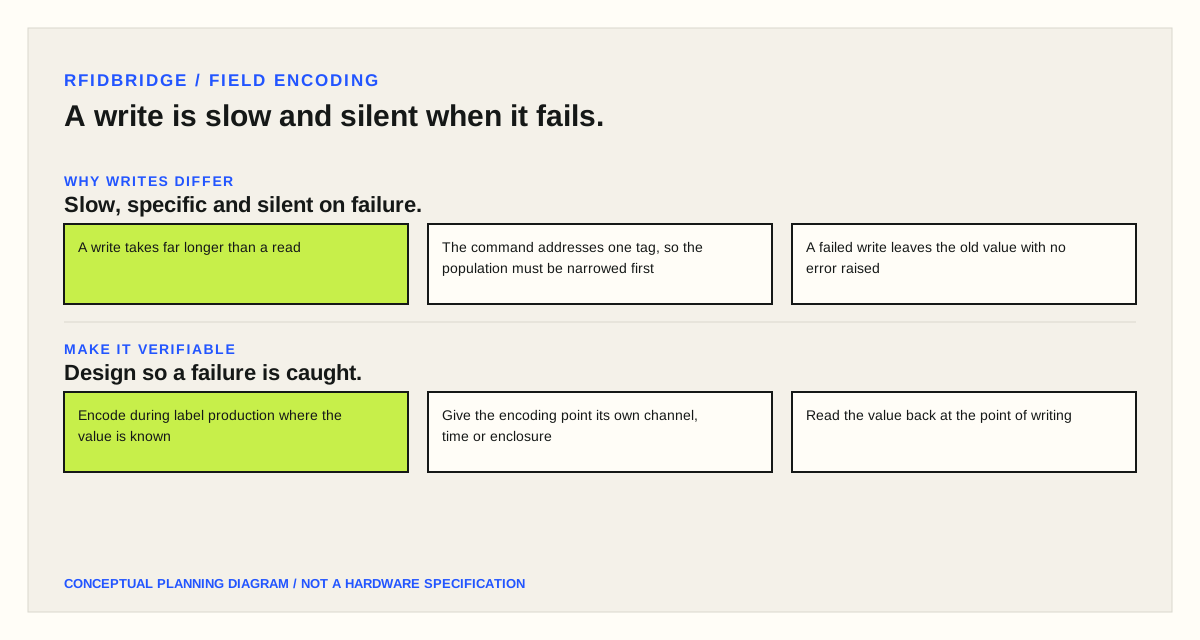
Writing to a tag is slow and silent when it fails. In a dense reader environment the write has to be isolated, verified and repeated under control.
01 / FIELD NOTE
Keep the decision tied to the operating context.
Reading a tag is fast and forgiving: if a reply is missed, the next inventory round brings it back. Writing is neither. A write command takes far longer than a read, and if it fails, nothing announces the failure — the tag simply continues to carry its previous value. In a dense reader environment, where several readers are transmitting nearby, both of those properties become problems.
The first issue is contention. While a reader is writing to one tag it needs that tag's replies to be received without interference, and a neighbouring reader transmitting on an overlapping channel is exactly the condition that prevents it. This is the same masking effect that dense-reader operation is designed to manage, but the cost of a failure is higher, because a lost read is retried automatically while a lost write is not.
The second issue is population. A write command addresses a specific tag, so the reader has to be sure which tag it is talking to. In an environment where dozens or hundreds of tags are within range, identifying the intended tag means narrowing the population first — using a Select command to restrict which tags respond, then inventorying to establish that the intended tag is present and where it is, then accessing it.
The practical response is to separate writing from the busy environment rather than compete with it. Where the identifier is known in advance, encoding during label production or at a dedicated station keeps the write in a quiet place at a controlled rate, and the tag arrives at the point of application already carrying its value. This also makes the write verifiable, because the same station can read the value back immediately.
Where writing must happen in the field, the design has to make the write reliable rather than assume it. Options include giving the encoding point its own channel or time slot, using a short-range reader or a shielded enclosure so the intended tag is the only one in the field, and adding an explicit read-back step so a failed write is detected at the point of failure rather than discovered later when the tag reports the wrong value.
Dense-reader mode itself is a prerequisite rather than a solution. It lets multiple readers operate in close proximity without interfering, and it only works if every reader in the environment is configured for it — one reader left in a different mode can undermine the arrangement for the others. Frequency hopping and listen-before-talk reduce the chance that two readers transmit on the same channel at the same moment, and a coordinating controller that allocates time windows removes the chance entirely at the cost of throughput.
The design question is therefore not how to write quickly but how to write verifiably. Any workflow that writes tags in the field should have an answer for what happens when a write fails silently: where the failure is detected, what the system does about it, and whether a tag carrying the wrong value can reach a point where that value is trusted.
02 / WHY WRITES DIFFER
Slow, specific and silent on failure.
- A write takes far longer than a read
- The command addresses one tag, so the population must be narrowed first
- A failed write leaves the old value with no error raised
03 / MAKE IT VERIFIABLE
Design so a failure is caught.
- Encode during label production where the value is known
- Give the encoding point its own channel, time or enclosure
- Read the value back at the point of writing
Bring the item, material, movement, target read and system context to a sample or project review.
Request a sample test