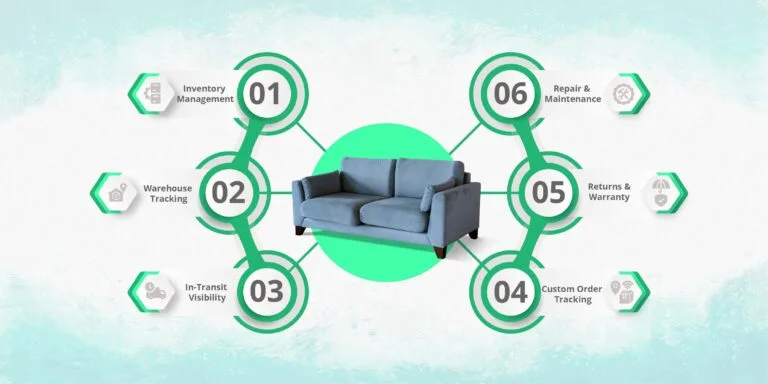
Bulky, low-volume, high-value goods sold from a showroom and a warehouse at once. The inventory problem is knowing what is displayable, what is in the back, and what is still with the supplier.
01 / FIELD NOTE
Keep the decision tied to the operating context.
Furniture retail has an inventory profile unlike most retail. The unit count is low, the unit value is high, and each unit is large enough that it occupies the space a whole category would in a clothing store. Counting is not the problem — there is very little to count — and knowing what is where and what can be sold is the problem instead.
The showroom and the stockroom are two different states of the same asset and they carry different commercial meanings. A sofa on display is committed to selling, cannot be sold as new, and cannot be moved without a decision. The same sofa in the warehouse is stock. A record that treats both as a quantity has lost the distinction that the sales floor needs to make.
The third state is stock that has not arrived. Furniture is frequently sold from a display or a catalogue before the goods are on site, and the item may be at a supplier, in transit, or in a container. That state is not a location in the building, and a record built around warehouse locations cannot hold it — which is why the reservation and the physical receipt have to be tracked as separate facts.
Item-level identity matters here for a reason different from apparel. Where a garment’s identity resolves to a size, a furniture unit’s identity resolves to a specific object with a finish, a fabric, a batch and a condition. Two units of the same model are not interchangeable in the way two identical shirts are, and a buyer who has seen a display piece expects the delivered item to match it.
Condition is a first-class attribute rather than an exception. A display model, a returned item, a unit with a transit mark and a new unit in its packaging are all the same product at different values. A record that cannot distinguish them will offer the wrong one, and the failure is discovered by a buyer at delivery rather than by staff at the point of sale.
Movement is infrequent and heavy, which changes what tracking has to do. Goods are moved by trolley or forklift, in and out of large bays, and the events worth capturing are few and significant rather than many and routine. That is a favourable profile for a read at a defined point — a bay entrance or a loading door — rather than for continuous volumetric visibility.
The physical constraints are the ones that dominate the design. Metal frames, springs and fittings change how a tag behaves; solid wood and foam density shield; and the goods are large enough that a tag on one face may be unreadable from the position a reader occupies. A tag mounted on a discreet, consistent position, validated against the actual product range, is what makes the difference between a working system and an intermittent one.
Where the tag sits also has to respect the product. A branded label on a garment is normal; a tag on a finished piece of furniture is a design decision, and it has to be somewhere that survives handling, does not mar the finish, and can be removed at delivery without leaving evidence. The technical requirement does not override the product, and a solution that damages the item has failed on its own terms.
Delivery scheduling is the operational question the record most obviously serves. A buyer is given a date, and the ability to keep it depends on knowing that the specific unit is on the premises, in a deliverable condition, and allocated to that order. Those are three facts, and the failure that damages a furniture retailer’s reputation is a promised delivery that cannot be made because one of them was wrong.
Supplier and transit visibility is where the improvement is largest, because that is where the information is weakest. Goods made to order, shipped in containers, and cleared through customs have several points at which the expected date can slip, and a record that only begins when the goods arrive cannot warn anyone in time to manage the buyer’s expectation. Extending identity upstream is the part that changes what can be promised.
Returns and repairs are a larger share of the volume than in most retail, and they are the flows that most often leave the record. A returned item awaiting inspection, one in for repair, and one written off are all physically present and commercially distinct. A record that marks everything as returned without a disposition will overstate what can be sold, which is the same failure mode as anywhere else and more expensive here.
The realistic scope is a record that knows which specific piece is where, in what state, and committed to what — and that extends far enough upstream to make a delivery promise. That is a narrower ambition than continuous visibility and a more useful one, because furniture retail does not have a counting problem. It has a problem of knowing what a particular item’s situation is, and that is what identity answers.
02 / THE STATES
A quantity cannot hold these apart.
- On display, committed to selling and not sellable as new
- In the warehouse, available stock
- Still with the supplier or in transit
- Returned, awaiting repair, or written off
03 / WHAT THE DESIGN MUST RESPECT
Few, heavy, high-value movements.
- Metal frames and dense foam, which change how a tag behaves
- A mounting that survives handling and does not mar the finish
- Reads at a defined bay or loading point rather than continuous
- Identity upstream, where the delivery promise is actually formed
Bring the item, material, movement, target read and system context to a sample or project review.
Request a sample test