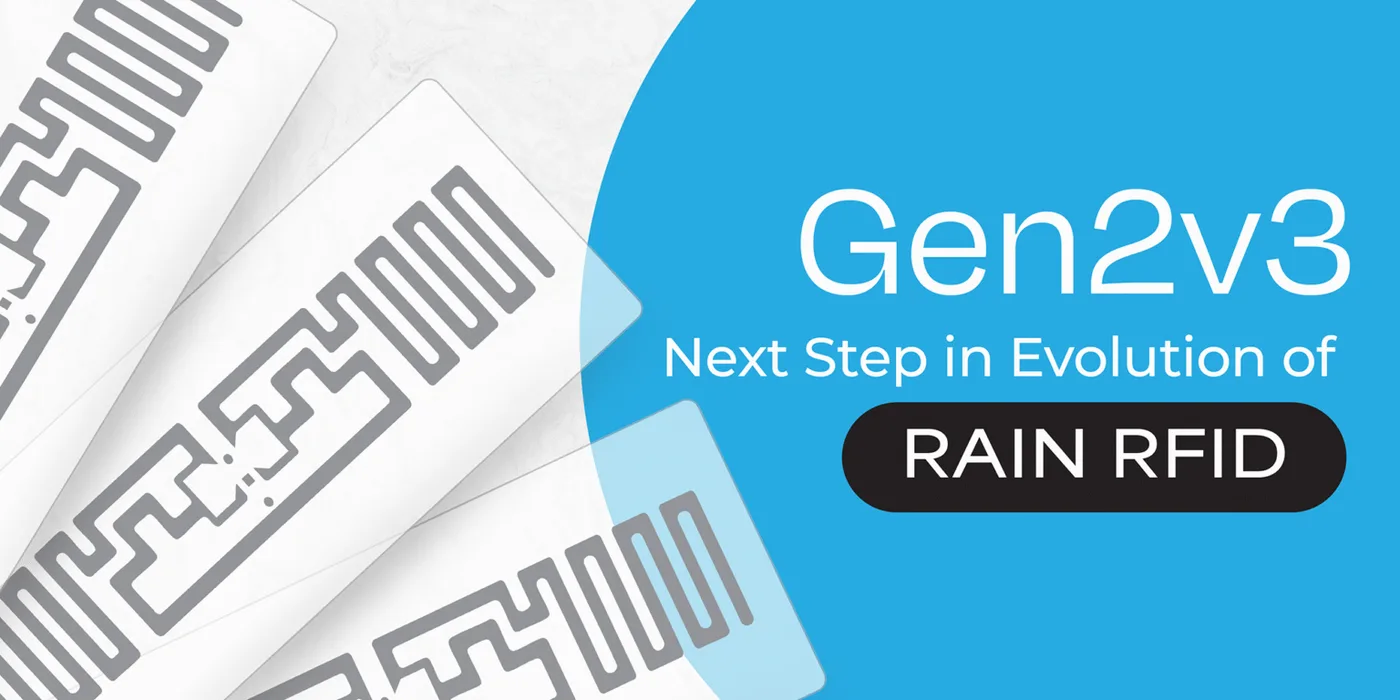
Gen2v3 revises the EPC UHF air-interface protocol in four places: the spectral efficiency of the return link, how a dense tag population is inventoried, how a tag proves its identity, and how its user memory is structured. What an existing Gen2v2 deployment actually gains — and what it must not have to change — follows from those four mechanisms.
01 / FIELD NOTE
Keep the decision tied to the operating context.
A protocol version number is easy to mistake for a firmware detail, but for a passive UHF system the air-interface protocol is the whole language of the link. It fixes how a reader charges a tag, how a tag answers by backscatter, how many tags may answer in one round, in what order, and with what assurance. Gen2v3 is the third revision of the GS1 EPC UHF air-interface protocol, and the practical question behind it is simple: what does a deployment that already runs Gen2v2 actually gain, and what must it change to gain it? The answer is spread across the physical layer, the inventory exchange, the security layer and the memory model, and it is different in each place.
The protocol is really four mechanisms under one name. The physical layer decides how energy reaches the tag, how the tag modulates its backscatter, and how fast bits move in each direction. The inventory layer decides how a reader with thousands of tags in its field gets each serial in turn without answers colliding. The security layer decides who may read a tag and what proves it. The memory layer decides what a tag can store and how that storage is addressed. Gen2v2 reached its final form in 2013, when both tag populations and read zones were smaller. Gen2v3 revises all four mechanisms for dense fields, multi-reader sites and data-carrying tags — and because the revision is additive rather than replacement, each layer changes on its own terms.
Spectral efficiency is the first change, and it lives in the return link. A passive tag answers the reader by modulating its radar cross-section: it switches its antenna impedance to reflect more or less of the reader's carrier, and how many bits per second that reflection can carry is set by the encoding and the modulation in force at that moment. Earlier protocol generations fixed one scheme and made every tag in the field use it. Gen2v3 adds adaptive modulation and coding, where the pair negotiates an encoding matched to the link conditions a particular tag actually sees, so weak and strong responders are no longer forced through the same channel. The point is not a headline speed; it is more completed exchanges inside a given inventory session, which is what a dense field with a short dwell time needs.
The inventory exchange is the second change, and its vocabulary is Q and the session. When a reader runs an inventory round it frames a number of slots, and every tag picks one slot at random and answers there; if two tags pick the same slot the response collides and the frame is run again. The slot count is two to the power of Q, so the reader chooses how crowded the frame is by choosing Q. Gen2v3 refines how quickly the reader fits Q to the population it actually observes, how it re-runs only the collided slots rather than the whole frame, and how it walks up to a large population in stages instead of one frozen frame. Sessions let the same physical tag present different states to different readers, so two systems sharing a zone do not keep re-inventing each other's tags.
Clutter and fringe are the failure modes this revision most directly targets, and they are different failures. Clutter is surplus population: tags from a neighbouring use — another line, another system sharing the band — sitting inside the read zone and answering every round. The answer is filtering: the inventory round carries its own criteria, and tags that do not match are persuaded to stay silent, so the count reflects the intended set. Fringe is underpower: a tag at the edge of the interrogator field wakes and starts an exchange, then cannot complete it, and a reader that waits on it squanders the slot. Gen2v3 treats an incomplete response as a lost slot, moves on, and returns for the fringe tag with settings suited to its weaker link. The null zone — where reflected and direct waves cancel and the tag never hears the carrier — no inventory logic reaches.
The security layer is where the change is most visible. Gen2v2-era protection rests on access passwords plus optional vendor-specific commands, and a password is a shared secret that travels between reader and tag: a listener with a receiver near the read zone can capture it and replay it. Gen2v3 moves to authentication. The tag proves to the reader that it is the genuine item, and the reader proves itself to the tag in return, so an unknown interrogator cannot silently read a tag's memory or inject a forged serial into a population. The cipher suite is standardized rather than proprietary — AES-class symmetric ciphers and elliptic-curve public keys — and standardization does real work here, because cloning resistance on a tag is only as strong as the key that signs the identification exchange.
The memory model is the third change. A classic Gen2 tag exposes four fixed banks — reserved, EPC, TID and user — and the user bank is an undifferentiated byte range that every application has to carve up for itself. Gen2v3 layers structure on top of that bank: a file-style model splits the user space into named, length-bounded regions, each with its own access policy, and it defines two concrete encodings for the records, Tag-Length-Value and JSON. A TLV record starts with its type and its length, so a reader that does not recognize a record type can skip it cleanly instead of misparsing everything after it; JSON gives the application layer a document it can consume without a bespoke binary parser, which is what makes the tag's data fit systems that already exchange JSON natively.
Backward compatibility is the constraint that keeps all of this additive. A Gen2v3 reader still inventories a Gen2v2 population, and a Gen2v2 reader still reads a Gen2v3 tag, because the new capabilities ride on new commands and new code points rather than on a rewritten base exchange. Each side announces the level it supports, and any interaction falls back to the level the older side understands. The practical consequence is that nothing existing is disrupted: a Gen2v2 site keeps its current behaviour, and the new features engage only where reader, tag and application all implement them. The path is therefore staged — the reader infrastructure can move first, tag populations can follow at production refresh, and neither step breaks the other.
What does not change is the physical layer's fixed points. A Gen2v3 tag is still a passive device powered by the interrogator's carrier, and it still answers by modulating its own radar cross-section. The limits of that link — how far a tag can sit from the reader, how much energy a tag needs to wake, how a tag behaves in a null zone — are set by physics and by the band the region's frequency allocation rules make available to UHF RFID, commonly the 860-928 MHz span outside envelope restrictions. A protocol revision can spend that channel more carefully, but it cannot widen it: the available spectrum, the regional transmit limits and the tag's own power budget all lie outside the standard's reach.
The honest limit is that the standard delivers nothing by itself. Gen2v3 was drafted by a multi-organization workgroup and must pass peer review and community review before ratification, and reaching a given site depends on reader firmware and tag silicon being updated — a tag printed months ago implements the version it was born with, and an old reader base does not acquire the new inventory logic by wish. The revision also leaves unsolved what no protocol version can solve: a tag in a deep null zone is invisible to every revision, and a tag detuned by its mounting reads badly no matter which standard it speaks. The question a site should ask is not whether Gen2v3 arrives, but which of its own problems the four revised mechanisms actually address.
02 / THE THREE REVISED MECHANISMS
Spectral efficiency, population handling and authentication each change on their own terms.
- Adaptive modulation and coding fit the return link to the field a tag actually sees
- The inventory frame re-runs collided slots instead of the whole round
- Sessions and filter criteria exclude populations the reader does not intend to count
- Reader and tag authenticate each other instead of sharing a travelling password
- The user bank becomes structured TLV and JSON files with per-file access policy
03 / CLUTTER, FRINGE AND NULL ZONES
Three different ways a tag sits in the zone yet never contributes a counted serial.
- Clutter: surplus tags from a neighbouring use answer every round, until filters quiet them
- Fringe: tags that wake at the edge and cannot finish are treated as lost slots and revisited
- Null zone: direct and reflected waves cancel, so the tag never hears the carrier at all
- Q sets the frame size as a power of two, and the population spreads its answers across it
- The round moves on with what completed and comes back for the weak with adjusted settings
04 / BACKWARD COMPATIBILITY
The change is additive: new commands and code points, not a rewritten base exchange.
- A Gen2v3 reader still inventories a Gen2v2 population
- A Gen2v2 reader still reads a Gen2v3 tag
- New features engage only when both ends declare support
- Existing Gen2v2 sites keep their current behaviour
- Powering, backscatter and the band are outside the standard's reach
Bring the item, material, movement, target read and system context to a sample or project review.
Request a sample test