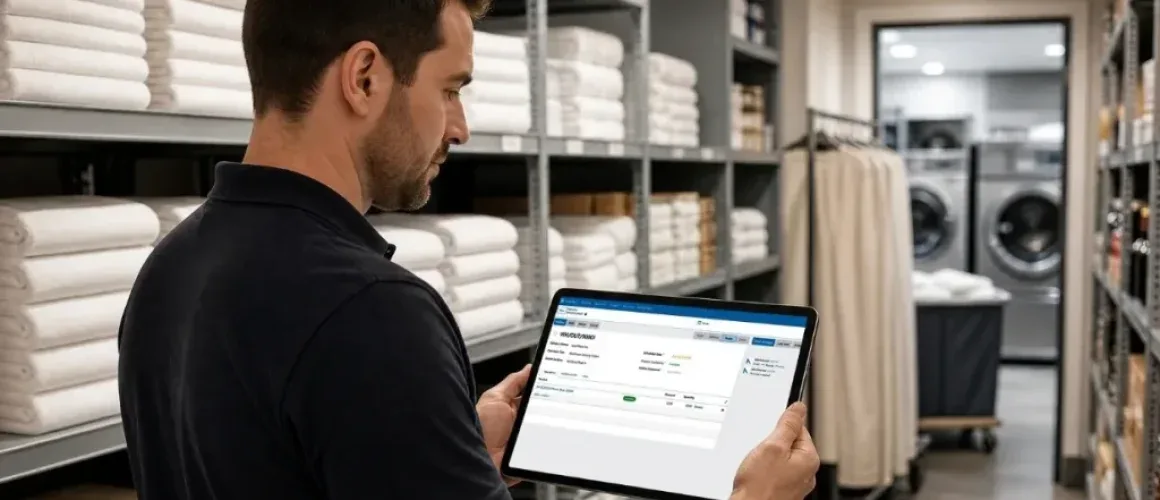
Hotel linen moves through guest room, laundry, storage and back, and the movement defeats a count. Four categories — bed, bath, table and staff linen — set the inventory frame, and the wash cycle is where the tag earns its place, recording the life of each piece.
01 / FIELD NOTE
Keep the decision tied to the operating context.
A hotel runs thousands of linen items every day — sheets, towels, robes and uniforms — and each one moves through the same loop: guest room to laundry to storage and back. The loop is the reason linen management defeats a count: an item is not in a place, it is between places, and the movement is handled by housekeeping teams, laundry staff and storeroom staff who do not share a ledger. The failure is not that the pieces are unaccounted for; it is that no account was ever taken near the moment of handling.
The first discipline is categorization, because the inventory frame has to match how items actually move. The four categories are bed linen — sheets, pillowcases, duvet covers, mattress protectors, changed and washed most often; bath linen — towels, robes, mats, moving outside guest rooms most often; table linen — cloths and napkins from restaurants and events, crossing departments; and staff linen — uniforms and kitchen textiles assigned to people. Category sets the tracking rule that follows: what is counted by room, by department, by event, and by person.
The manual methods each fail at the scale the loop demands. Paper records and spreadsheets describe what was counted on a day; a count that runs weekly reconciles a record against a loop that turns daily. The failure compounds twice: the count is late, so the discrepancy is discovered after the fact, and the count is by hand, so the transcription itself introduces error. A hotel that over-purchases to buffer the uncertainty pays twice for the broken count — once for the surplus, once for the loss it was trying to hide.
The questions the operation actually needs answered are movement questions: where is each item, which department handled it, when was it last washed. These are events, not totals — and an RFID tag on each piece turns each handling into a recorded event. Because the read needs no line of sight, a laundry rack, a cart, a door or a shelf becomes a read point without the aiming step a barcode demands and without the count-by-sight a human takes. The flow between departments is exactly where the reads earn their place: the tags are read where the linen is moved, not where somebody remembers to count it.
The wash cycle is where the tag’s second value appears: lifecycle rather than location. Each piece carries its identity through every wash, so the record accumulates the facts that decide replacement — first-use date, wash count, usage history. That frees the hotel from the two failure modes of estimate: replacing usable linen too early, or continuing to use linen that is done. The laundry cycle decides what a piece is worth, and the tag makes each cycle countable.
The practical geometry of the read points matters as much as the tag. A laundry door reads incoming and outgoing loads in bulk and reconciles them to the room counts; a dispatch point records what went to which floor; a receiving point confirms what came back. What the hotel gets is not a count but a loop — each leg of the guest-room-laundry-storage circuit is a read, and the discrepancy surfaces at the leg where it happens, rather than at the end of the month.
The honest limit of the mechanism is that a read records the piece’s passage, and it does not decide the piece’s fate. The tag says this sheet passed through the laundry door this many times; it does not say which room it should return to or when the fabric is truly exhausted — those are policies layered on the record. What the read buys is that the record is real: category, movement and wash count are facts, and the policies about replacement, allocation and shortage are then decided against facts rather than against a column of estimates. The loop is what makes the linen countable; the categories decide what to count together.
02 / FOUR CATEGORIES
The inventory frame follows the movement.
- Bed linen: sheets, pillows, duvets — changed most often
- Bath linen: towels, robes, mats — moving room-to-room
- Table linen: restaurant cloths and napkins — crossing departments
- Staff linen: uniforms and kitchen textiles — assigned per person
03 / THE LOOP
Guest room, laundry, storage, back.
- Each handling becomes a recorded event, no aiming
- A door, cart or rack is a read point without line of sight
- Discrepancies surface at the leg where they happen
- Hand counting is late twice: late and by hand
04 / THE WASH RECORD
Lifecycle, not location.
- First-use date, wash count and usage ride the identity
- Replacement follows count, not estimate
- A laundry door reconciles loads against room counts
- The record is real; allocation policy is layered on top
Bring the item, material, movement, target read and system context to a sample or project review.
Request a sample test