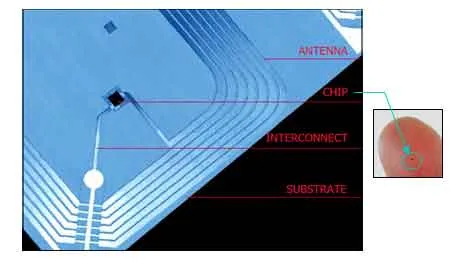
A tag is an integrated circuit, an antenna and a substrate, made by three different industries and joined at high speed. Which process forms the antenna, which material the substrate, and whether the tag is stock or custom, all follow from the application.
01 / FIELD NOTE
Keep the decision tied to the operating context.
An RFID tag is three things joined into one: an integrated circuit that holds the identity and logic, an antenna that exchanges energy and data with the interrogator, and a substrate that holds the two together. The interesting part of tag manufacture is that the three components come from different industries and are joined by none of them alone — the chip is designed and made by a semiconductor manufacturer, the antenna is usually designed and made by the tag manufacturer, and the substrate is a materials product. A tag assembler is an integrator of three supply chains, and the economics of each stage follow.
The chip is a small microprocessor: a logic unit that decides, memory that stores, and a power-management section that governs how the tag draws energy. The power comes from either a battery on the tag, for an active tag, or from the radio energy radiated by the interrogator antenna, for a passive one. Modern chips carry tens of thousands of transistors — more than the processor of an early home computer — and the difficulty of tag assembly climbs as the chip shrinks, because attaching a smaller die to the antenna needs more precise equipment and more cost. The chip sets the floor of the bill; the assembly sets the next step.
The antenna is the largest part of the tag and the part where the material science shows. For an active tag the antenna transmits; for passive and semi-passive tags it reflects the interrogator’s signal back and, in the passive case, also collects the power to run the chip. The metal is usually a thin strip of copper, aluminium or silver deposited on the substrate at speed. The three deposition methods form a cost-versus-performance ladder: copper etching is precise and efficient, foil stamping is faster on long runs, and screen-printing with conductive ink is the quickest and the cheapest of the three but yields a less efficient antenna.
The substrate sits beneath it all and does more than hold the parts. It must dissipate static buildup, give a smooth, printable surface for the antenna layout, survive the environmental ladder of the tag’s life — heat, moisture, vibration, chemicals, sunlight, abrasion, impact — and protect the antenna, chip and their interconnections. Most passive tags use a flexible plastic film a fraction of a millimetre thick; rigid options exist for special shapes. A subtle constraint: the substrate material shifts the design frequency of the antenna, so the choice of material is a radio engineering decision, not a packaging one.
The deposition and the substrate are where the tag’s form factor takes shape. Screen-printing a conductive ink is the natural fit for label makers, whose whole craft is printing at speed and low cost — the antenna is printed as part of the label, and the tag becomes an inlay that the label industry already knows how to handle. That route is why the commonest tags are also the cheapest: the process that forms the antenna is the label process itself, and the ink is the same family as the label printing.
The customization decision is economics, not craft. A tag can be sized, shaped and tuned for a particular application — a shape that fits a pallet, a frequency tuned for a material, a tough housing for a tool. But stock tags produced in volume amortize the design and the tooling, while a custom tag carries the design, setup and smaller-run costs. The rule the source states plainly: unless the requirement is a very large number of tags, use stock tags, because the custom price premium rarely buys back what it costs.
The honest limit of the construction story is that it explains the parts and the processes, and the performance of the finished tag is decided by the interactions between them — the substrate that shifts the frequency, the adhesive that holds chip to antenna, the housing that protects or the environment that attacks. The construction of a tag is therefore not a bill of materials but a set of trades, each stage exchanging cost for a property. Knowing how the three parts are made is the map; choosing which trade each application can afford is the engineering done on top of it.
02 / THREE PARTS, THREE INDUSTRIES
An integrator of supply chains.
- Chip: the logic unit, memory and power control from a semiconductor maker
- Antenna: the exchange element, usually designed by the tag maker
- Substrate: the structural and electrical ground under both
- A tag assembler joins three industries’ products
03 / THE ANTENNA LADDER
Cost versus efficiency per process.
- Copper etching: precise and efficient
- Foil stamping: faster on long runs
- Screen-printing: quickest and cheapest, lower efficiency
- Printed ink antennas ride the label printing process
04 / STOCK VS CUSTOM
A decision about volume.
- Custom tags trade design and setup for fit
- Stock tags amortize the tooling across volume
- The substrate shifts the design frequency
- Unless the run is huge, stock wins the economics
Bring the item, material, movement, target read and system context to a sample or project review.
Request a sample test