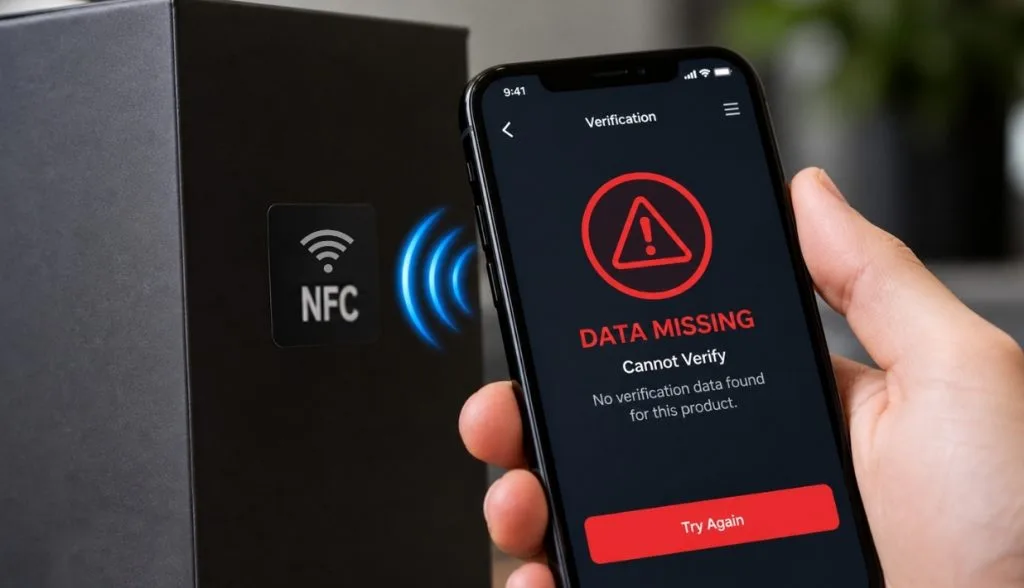
Barcodes identify an item and enterprise records describe a flow, but neither validates the physical component at the point of interaction. NFC closes that gap by carrying a unique, verifiable identity that a handheld can authenticate on the spot.
01 / FIELD NOTE
Keep the decision tied to the operating context.
Electronic supply chains move components across several fabricators, assemblers and distributors, and the question that recurs at every handover is not whether the part is the right part but whether it is the part it claims to be. A component counted as present in a system of record can still be a substituted or reworked part, because the record knows quantities and flows, not the physical part. Traceability in this supply chain means tying identity to the component in a way that survives the hand and is checkable by the person touching it.
The familiar tools each fail at a different point. A barcode or printed code on a reel or tray states an identity, but the code is printed artefact — it can be copied, relabelled or moved, and nothing about the code itself answers whether the component matches it. An enterprise resource-planning record is even further away: it describes what was supposed to happen, updated later and at the level of lots or shipments, and a discrepancy inside a received batch is invisible to it until something goes wrong downstream. Both solve the bookkeeping of traceability; neither validates the part.
The NFC contribution is a distinguishing identity that lives on the component and is verified by radio interaction rather than by sight. A tag embedded on a board, a module or a package holds a unique identifier that is not printed on any surface a counterfeit could mimic, and the reader interaction is directional: the counterfeiter has to reproduce the radio behaviour, not a label. That is the structural difference the supply chain exploits: identity that a handheld can challenge at the point of receipt, inspection or installation.
Authentication goes a step past distinguishing identity. A cryptographic NFC tag answers a challenge that only a tag holding the right secret can answer correctly, so the read does not simply report "this identifier exists" but "the tag that holds it is the genuine tag". For a high-value component — a controller, a radio module, a part that flies or fails — that is the property the manufacturer is paying for. The point of interaction, a qa bench or a receiving dock, becomes a place where genuineness is decided on the spot instead of days later in a failure report.
The scan itself leaves a trace. Every interaction with the tag can be appended to a record held against the identifier: fabricated here, tested there, shipped on this date, received by that facility, installed in that unit. Because the identifier is unique to the item, not to the lot, the trail is item-level, and a recall or a field failure can be traced to the single component. The trail is built from the interactions that already happen; the contribution is that each one is anchored to a radio-authenticated identity.
The role split with conventional RFID matters for design. UHF RFID reads many tags in a pass and is the tool of bulk inventory — counting a drawer of parts, verifying a shipment against a list. NFC interacts close-range, one device at a time, and is the tool of item-level proof: this specific part, touched by this person, authenticated here and now. The supply chain uses both — bulk movement measured by UHF, identity and provenance asserted by NFC at the points where a wrong part would be catastrophic.
The environments the tags must survive set the practical boundary: reflow-soldering heat and wash steps in board assembly, pressure and chemical exposure in logistics, vibration in transit. The distinguishing-identity benefit holds only while the tag rides with the component through the processes that would destroy a paper label; an inlay that fails in the first reflow removes the mechanism at the point it matters. The choice of tag construction is therefore part of the traceability design, not a packaging detail.
The honest limit: the mechanism authenticates the tag and the record it anchors, and what it cannot do is authenticate the component independent of the tag. A tag removed from a real part and carried to a substitute is still the tag of the real part. The countermeasure is the pairing — a tag bonded or embedded so that detaching it damages it — which is why the physical integration of tag and part is as much a security decision as the cryptography. Traceability built on NFC is a strong chain; its strength still ends where the bond and the radio handshake end.
02 / WHAT EACH TOOL PROVES
The gap is validation, not bookkeeping.
- A barcode states an identity that can be copied or relabelled
- An ERP record describes flows at lot level, later than the part
- Neither answers whether the physical part is what it claims
- NFC adds a radio challenge only the genuine tag answers
03 / THE ROLE SPLIT
Bulk measurement and item-level proof are different tools.
- UHF bulk reads measure what is in the drawer or the shipment
- NFC close-range interaction asserts identity on one part at a time
- Authenticated scans build an item-level trail from fabrication to install
- The trail makes a recall traceable to the single component
04 / THE BOUNDARY
The proof is only as strong as the bond.
- The tag must survive reflow, wash and transit with the part
- A tag carried to a substitute part is still the genuine tag
- Embedded or bonded tags make detachment destructive
- The radio handshake and the physical pairing are one security decision
Bring the item, material, movement, target read and system context to a sample or project review.
Request a sample test