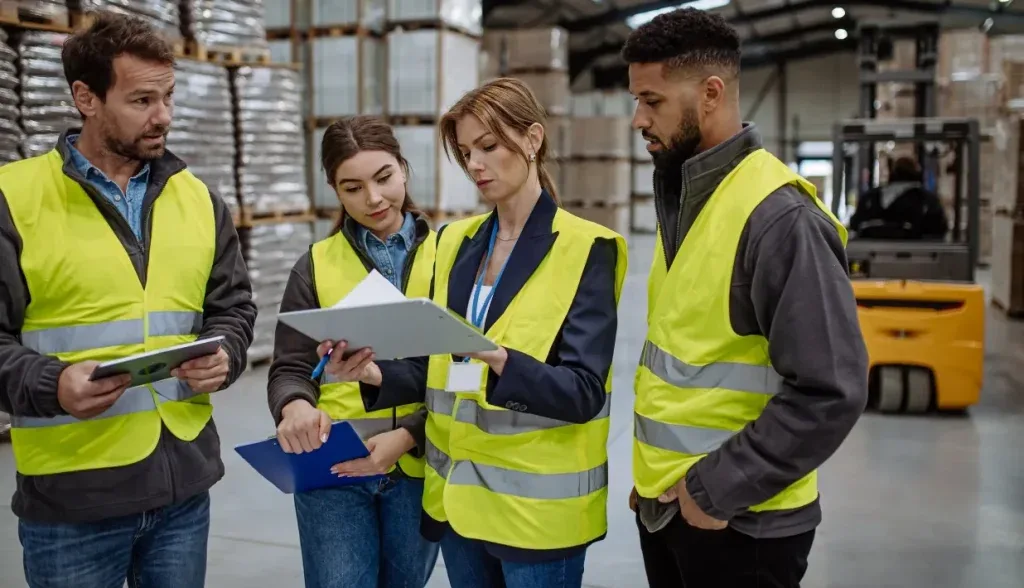
Manual counting is not expensive because of the counting. It is expensive because of the interruption, the transcription, the errors it leaves behind and the decisions made against a figure that was already old.
01 / FIELD NOTE
Keep the decision tied to the operating context.
Manual counting gets justified by the hours it takes, and the hours are the smallest part of the cost. A count is a labour task with a duration, so it gets budgeted like one: people, days, overtime. Then it is approved, run, and the real costs arrive afterwards, in the form of decisions that were made against a figure nobody had time to question.
The first hidden cost is the interruption. A full count rarely happens alongside normal work; either the operation slows or it stops. Stopping a warehouse is not a neutral act, because inbound and outbound do not stop with it. The work is not avoided, only deferred, and it returns compressed into a shorter window with the same people.
The second is transcription. Every manual count passes through at least one handover between paper and system, and each handover is a chance to introduce an error that is indistinguishable from a counting error once it is in the record. A count that was correct on the floor can arrive in the system wrong, and there is no way to tell those two cases apart afterwards.
The third is that a manual count captures quantity and little else. It establishes how many, usually at whatever level the counter was working at, and it does not establish which units, where they were, or whether they were in a sellable condition. That is sufficient for a financial reconciliation and insufficient for the operational questions the business actually asks of the record during the following months.
The fourth is latency, which is the most expensive and the least discussed. A count produces a true statement about the moment it was taken. Between that moment and the next one, the operation continues on a record that is progressively less true. The gap between counts is where the drift accumulates, and a rare count means a large gap.
The fifth cost appears when the count disagrees with the system and nobody can explain why. A variance is the point of the exercise, but an unexplained variance is only actionable if the record contains enough detail to trace a cause. Quantity-level counting rarely does, so the discrepancy is adjusted and the cause remains, which is why the same discrepancy recurs at the next count.
Bulk capture changes the economics by changing what a count is. Reading many tags in one pass removes the per-item time that made counting expensive, which means the count can happen more often, in smaller pieces, and alongside the work rather than instead of it. The value is not that the same count is faster; it is that a different counting rhythm becomes affordable.
The level at which goods are tagged decides what a bulk read can tell you, and choosing it is a real trade. Pallet-level tagging makes bulk movement cheap and can only ever report about pallets. Carton-level adds resolution at the cost of more labels and more care in application. Item-level is the only level at which the count can answer questions about individual units, and it costs the most per unit. The right choice is the coarsest level that still answers the questions the business asks.
Where the capture happens matters as much as how. A fixed reader at a dock door, a conveyor or a controlled gate captures movement as a by-product of goods going about their normal business, with nobody deciding to scan. A handheld captures wherever a person walks, which is more flexible and cheaper to start, and still depends on someone choosing to do it. The two answer different problems and most operations need both.
The system of record is what turns reads into stock. Capture without integration produces a second, parallel view of inventory, and reconciling two views by hand is worse than having one imperfect one. Whether the path from reader to record is a direct interface or something scheduled, it has to be decided, built and owned before the counting changes, not after.
Some counting has to remain manual and pretending otherwise causes trouble. Goods that were never tagged, items inside sealed containers, stock in a location the radio cannot reach, damaged units whose tags no longer respond — each of these needs a defined path rather than an assumption that the system will see it. A count process that has no answer for an unreadable tag will silently treat it as absent.
The honest measure of a replacement is not how much faster the count runs. It is whether the count happens often enough to matter, whether an exception can be traced to a cause, and whether anyone still keeps a private spreadsheet because the official figure cannot be trusted. The first is a stopwatch reading; the other three are the ones that decide whether the change held.
02 / THE REAL COSTS
Beyond the hours on the roster.
- The operation slowing or stopping while the count runs
- Transcription between paper and system
- Quantity captured without identity, location or condition
- Decisions made against a figure that ages from the moment it is taken
03 / WHAT CAPTURE ADDS
Changing the rhythm, not just the speed.
- Many tags in one pass, so counting can be frequent and partial
- Capture at a dock, gate or conveyor with nobody deciding to scan
- A defined path for untagged, unreadable or enclosed goods
- Integration into the system of record, or a second view to reconcile
Bring the item, material, movement, target read and system context to a sample or project review.
Request a sample test