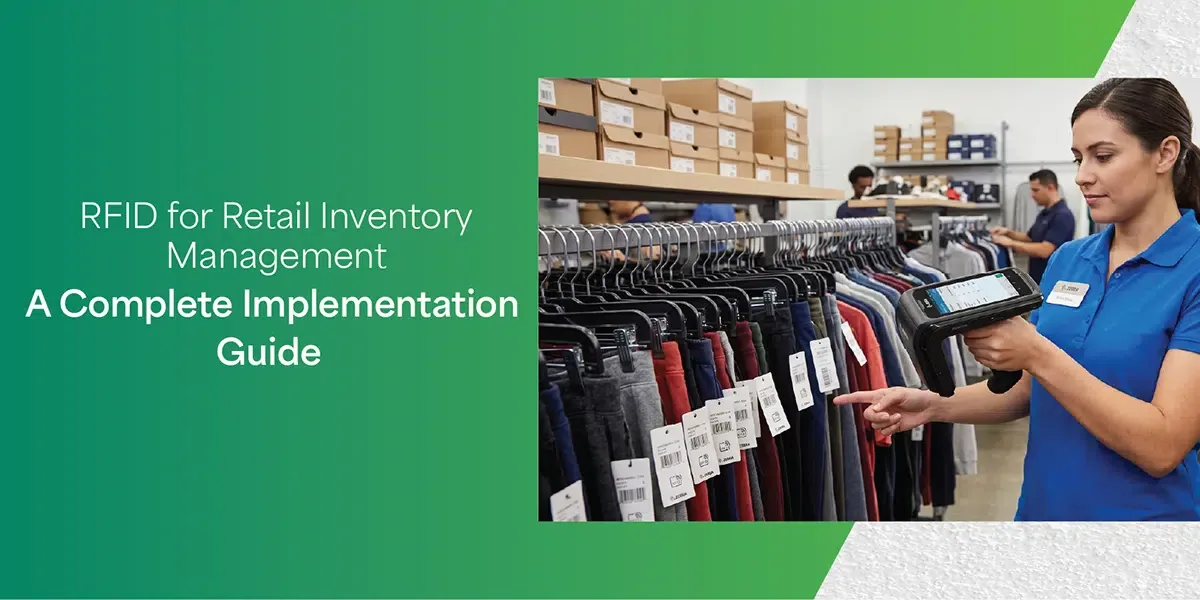
A retail deployment moves from tagging to counting to the sales floor. Getting the sequence right matters more than getting any single stage perfect.
01 / FIELD NOTE
Keep the decision tied to the operating context.
Retail is the application where item-level tagging is most established, and the sequence a deployment follows is what decides whether it delivers. The stages are well understood — tag the goods, count them accurately, and use the resulting record in the store — and they are dependent, so skipping to the visible one does not work.
Tagging comes first and sets a ceiling on everything after. Where an inlay is applied at the point of manufacture, the item carries its identity from the moment it exists, which makes receiving, counting and selling all able to reference the same thing. A tag applied in store covers only the part of the item’s life the store controls, and an item that arrived without one has no history before its first count. Both are legitimate starts; they support different questions.
The counting stage is where the accuracy is established, and it is the stage most often rushed because it is not the one the business is excited about. A store record is only as good as the count that maintains it, and a count that happens rarely leaves the record drifting by however much moved in between. Reading a whole shop floor in one pass is what makes a frequent count affordable, and frequency rather than thoroughness is what keeps the figure current.
The transition to the sales floor is not a technical step. It is a change in how staff use the record, and it depends on the record being trustworthy enough to act on in front of a shopper. If a sales assistant can check other stores for a size and trust the answer, the record has become part of selling. If they have learned to walk to the stockroom instead, the deployment has not changed how the business operates, whatever the count accuracy says.
The checkout is the point where the same identity serves a second purpose. A tag deactivated at the till removes the item from the security system and, if the sale is posted against the same identity, removes it from available stock in the same transaction. That is where inventory accuracy and loss prevention stop being separate projects — and it only works if the identity read at the till is the identity the record holds.
Returns are the flow retail handles worst and the one that most reliably corrupts the record. A returned garment is physically present and commercially unavailable at the same time, and both facts need recording. Without identity, a return is either put back without adjustment, which overstates availability, or removed from the record and set aside, which loses track of it. With identity, the original sale can be found and the item given a disposition.
Shrinkage needs to be separated from record error before either can be managed. A garment on the wrong rail is misplacement. One received in a short quantity is a supplier discrepancy. One that left without payment is shrink. A count that reports a single variance cannot be acted on, because two of those three are fixed in the back room rather than at the door — and the count design, not the security system, is what makes the difference visible.
Omnichannel is the requirement that turns the record into the product. Selling online from store stock, reserving for collection, and shipping from the nearest location all depend on a figure that is current and unit-level, because each commits a specific item to a specific buyer. A record that is approximately right produces promises that are approximately honoured, and in retail the failure is visible to a buyer who has already paid.
Store-level operational questions are where the benefit becomes day to day. Replenishment from the back room becomes a directed task rather than a walk; finding a specific item for a shopper takes a handheld rather than a search; a delivery discrepancy is caught at the door rather than at the next count. None of those is dramatic and together they are what staff notice.
The limits are worth stating because retail deployments are often oversold. Radio performance varies with what the goods are made of and how they are displayed, a dense rail of garments is a harder read than a folded stack, and fittings and fixtures can shield. Those are properties of the shop, and a measurement taken in the store — not in a demonstration — is what establishes whether the method holds.
Rollout should be staged by store, and the first store carries a disproportionate share of the learning. The questions that surface there — how the count fits into the trading day, what staff do when a tag will not read, who clears the exception queue — are operational rather than technical, and they are answered by running the process rather than by planning it. A second store benefits from the first store’s answers, which is the entire argument for not launching everywhere at once.
The measure of the deployment is whether anyone still keeps a private count. If the store manager maintains a separate tally for the lines they care about, the official figure is not trusted and the deployment has added cost without replacing the workaround. A record that is used, in front of shoppers and by the people who make replenishment decisions, is the only evidence that the implementation succeeded.
02 / THE SEQUENCE
Each stage enables the next.
- Tag at manufacture or in store — a different span of the item’s life
- Count often enough that the record stays current
- Let the sales floor use it, including in front of a shopper
- Deactivate at the till, posting the sale against the same identity
03 / WHAT RETAIL EXPOSES
Flows that corrupt the record.
- Returns present and unavailable at the same time
- Shrinkage, misplacement and receiving error reported as one variance
- Omnichannel commitments to a specific item
- Replenishment decided against a figure nobody trusts
Bring the item, material, movement, target read and system context to a sample or project review.
Request a sample test