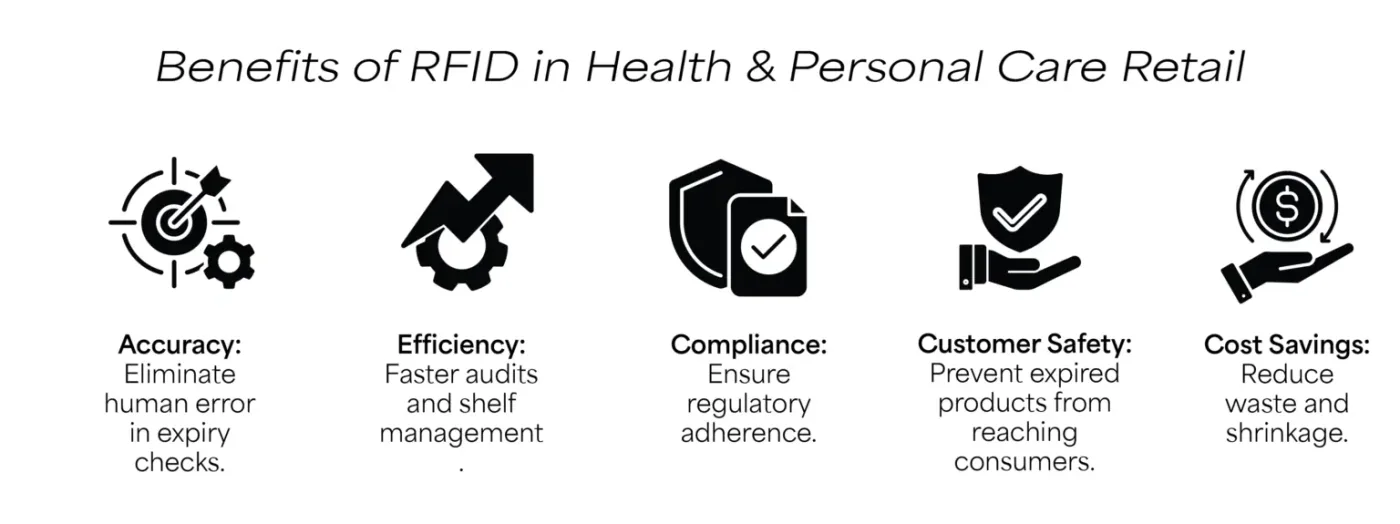
A sell-by date written into a product record does nothing until a scan can tie it to the physical item. Item-level RFID turns expiry into a field on the tag that bulk reads surface in real time, so removal and markdown decisions stop depending on someone walking the aisle.
01 / FIELD NOTE
Keep the decision tied to the operating context.
In a retail range where medicines, supplements and cosmetics sit side by side, thousands of stock-keeping units carry different shelf lives, and the expiry date is a property of the physical unit rather than of the aisle. A manual check walks the shelf and reads the printed date on each package; the failure mode is not misreading a label but never reaching it in time. The date exists in the warehouse system, and it exists on the package, and the two are reconciled by eye. That is the operating problem expiry tracking answers: making the bound on the physical item visible to a system without a person transcribing it.
A barcode answers poorly here because reading it is an act of aiming. Each barcode must be presented to a scanner one at a time, which means expiry checks are scheduled events — a quarterly walk-through or a spot audit — and between events the stock sits unexamined. The shelf life does not pause for the schedule. An RFID tag carrying the item record removes the aiming step: a handheld sweep or a fixed read point at a shelf or back-room door captures every tag in the zone without line of sight, and the read returns the record that carries the date.
The mechanism that makes this work is the tag memory layout. The expiry date is written into the item-level record at the point the unit is tagged — at receiving or at the distribution centre — so the bound travels with the unit rather than living only in a database keyed on a quantity. When a read happens later, the interrogator asks for the tag data and the software compares the date field against the current clock. The comparison itself is trivial; the change is that it is evaluated on every read, continuously, instead of on the cadence of a manual shelf check.
The bulk read changes what a check looks like. A handheld sweep of a shelf row returns every tagged unit in the zone, and the software partitions the returns into three classes: within bound, approaching bound inside a configurable window, and past bound. The operator acts only on the exceptional classes — pull the past-bound unit, mark down or reallocate the approaching one — and the everyday stock generates no line of work at all. The scan that was a quarterly event becomes an ambient property of any read the zone already performs.
The alert itself is a comparison, not a process. The same interrogator that logs a unit as present at a shelf, a back-room door or a point of sale can flag a date that has crossed its threshold while the unit is in motion, before it reaches the shelf. That is the practical difference from a barcode walk: the expiry check runs correlated with every other read the operation does, so a unit nearing its bound is surfaced at the moment of handling rather than at the next scheduled audit.
The record does not end at the shelf. The same item-level identity flows onward: when the unit reaches a register or an inventory system, the expiry field travels with the read and the system can act on it — block a sale of a past-bound unit, record a markdown at the moment of revaluation, or count a pull as a disposal instead of a mystery shrinkage. The data is written once and read many times, and each read point applies the same bound logic to the same field.
The write path is where the discipline lives. The date has to be bound to the exact unit, which means the encode happens at the point the identity is created — receiving, or the tagging station in the distribution centre — and the system of record for the bound is the tag record, not a note on a pick list. A tagged lot whose dates were entered against a batch rather than a unit inherits a batch bound, which is correct only while every unit in the lot shares it; the mechanism becomes precise exactly when the encode is item-level.
The honest limit of the mechanism is that it surfaces the bound and dates the action; it does not perform the action. A unit flagged past bound while its case sits on a high shelf still requires a person or a downstream process to pull it, and a read point that is never swept teaches the software nothing about that corner of the store. What the mechanism removes is the transcription step, not the decision step. The decision rules — window length, markdown policy, disposal accounting — remain configuration that each operation sets deliberately.
02 / THE RECORD
The date rides on the unit, not in a drawer.
- Expiry is written into the tag record at the point the unit is tagged
- The bound is item-level, distinct from a batch or aisle-level date
- Every later read returns the field with the identity
- The compare runs against the current clock on every read
03 / THE CHECK
A sweep replaces the walk.
- A handheld or fixed read captures the zone without line of sight
- Units sort into within-bound, approaching, and past-bound
- Only the exceptional classes generate work
- The comparison runs at handling moments, not on the audit calendar
04 / THE FLOW
The same field moves through every read point.
- Receiving or the tagging station binds date to unit
- Shelf and back-room reads surface approaching units
- A register read can block a past-bound sale at the moment of sale
- Pull, markdown and disposal are decisions the system surfaces, not performs
Bring the item, material, movement, target read and system context to a sample or project review.
Request a sample test