Encoding writes data into a tag's chip memory. Which bank it goes into decides whether it can be changed, who assigned it, and whether the tag can be killed after purchase.
01 / FIELD NOTE
Keep the decision tied to the operating context.
Encoding is the act of writing data into a tag's chip. A tag arrives from a supplier either blank or carrying a default value, and it stays that way until something writes to it. Unlike a printed barcode, the content can be changed after the fact, which is what allows a tag to carry a serial number, a batch code or a date that was not known when the label was manufactured.
The physical tag is two parts: the chip that stores data, and the antenna that lets the chip communicate. Encoding addresses the chip. A reader-writer, or a dedicated encoder in a label printer, sends the data over the air and the chip stores it.
Encoding matters for two practical reasons. First, tags bought in bulk may arrive carrying the same code, and encoding is what gives each one a distinct identity — without it, two items are indistinguishable to the system. Second, most business systems expect data in a defined structure, so the values written have to follow the scheme the receiving application understands.
UHF Gen2 chips organise memory into four banks, and knowing which bank holds what is the basis of any encoding decision.
Bank 0, reserved memory, holds the security codes: a 32-bit access password that lets a tag move into a secured state where write operations are permitted, and a 32-bit kill password that can permanently silence the tag. The kill password defaults to zero and the kill command only takes effect once a non-zero password has been set. In retail, killing a tag at the point of sale is a privacy measure — the item leaves the store with a label that can no longer be read.
Bank 1, EPC memory, holds the Electronic Product Code, typically 96 or 128 bits but extendable. This is the value readers report, and the one that identifies the object rather than the tag. Its layout includes a CRC-16 error-detection code, a protocol control word, and then the EPC itself. The protocol control word carries structural information: how long the EPC is, whether the tag has user memory at all, whether an extended protocol control word is present, and whether the data follows a GS1 coding scheme or an ISO/IEC 15961 one.
Bank 2, TID memory, holds the tag identifier — a value assigned by the chip manufacturer that cannot be altered or erased. It identifies the tag itself rather than the object it is attached to. Because it is immutable and unique, it is the reference used to check authenticity and to detect cloned tags, and it is also how an encoder can confirm which physical tag it just wrote to.
Bank 3, user memory, is optional and its size varies by chip, from around 512 bits up to several kilobytes. It holds data that does not belong in the EPC: maintenance logs, expiry dates, temperature records, or application-specific fields. Its first bits are a data storage format identifier that tells the reading system how to interpret the rest, so a system that writes user memory has to write that identifier consistently or the data becomes unreadable.
A Gen2 tag has a defined set of capabilities that follow from this structure: memory access control through the access password, memory locking, bit-masked filtering that lets a reader select a subset of tags by matching part of their data, a kill function for permanent deactivation, and cryptographic authentication on later versions for anti-counterfeiting. Reads run at well over a thousand tags per second in good conditions, while writes are far slower — in the range of a few tags per second — which is a strong argument for encoding tags before they are applied rather than in the field.
That asymmetry is the main encoding decision. Writing data during label production, where tags pass an encoder one at a time at a controlled rate, is quick and reliable. Writing to tags on a moving pallet in a live read zone is neither. Where the identifier is known in advance, encode first; where it is generated at the point of application, plan for the time the write takes and verify it rather than assuming it succeeded.
02 / FOUR BANKS
Where each kind of data lives.
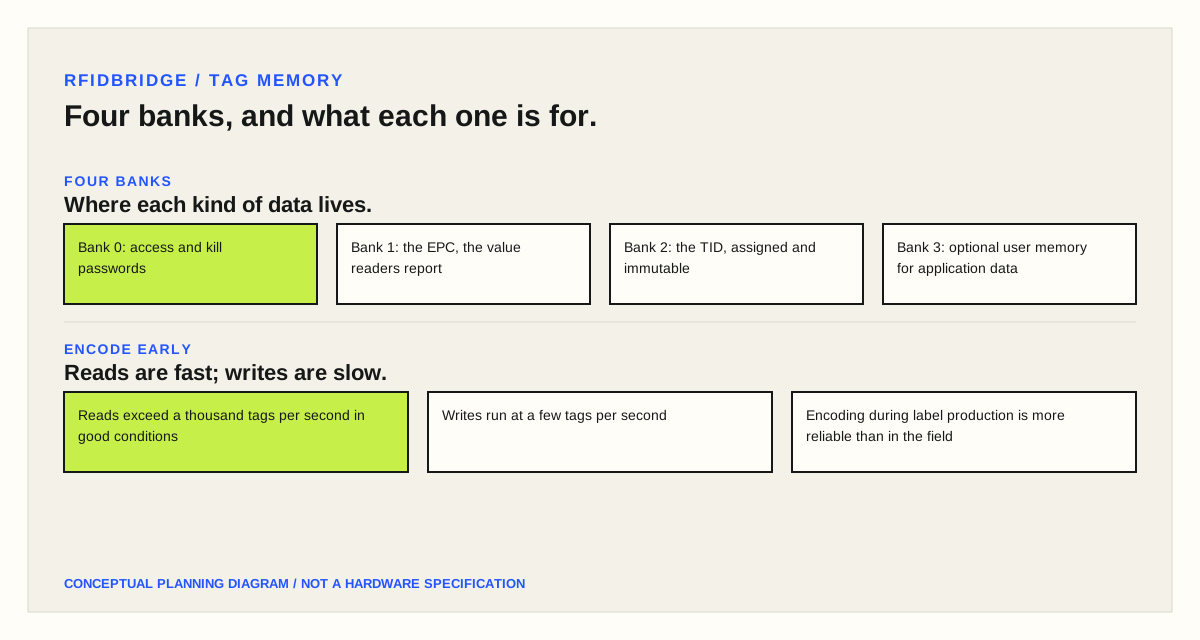
- Bank 0: access and kill passwords
- Bank 1: the EPC, the value readers report
- Bank 2: the TID, assigned and immutable
- Bank 3: optional user memory for application data
03 / ENCODE EARLY
Reads are fast; writes are slow.
- Reads exceed a thousand tags per second in good conditions
- Writes run at a few tags per second
- Encoding during label production is more reliable than in the field
Bring the item, material, movement, target read and system context to a sample or project review.
Request a sample test