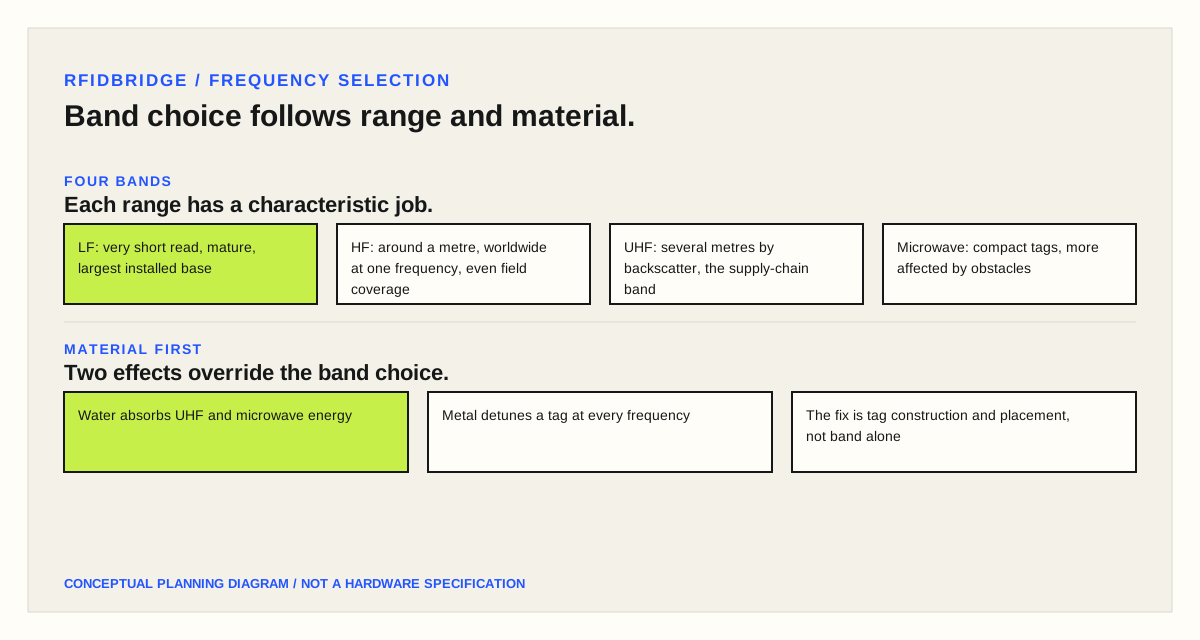
Frequency decides read range, how the tag couples to the reader, and how water and metal affect it — the three constraints that shape tag selection more than any other.
01 / FIELD NOTE
Keep the decision tied to the operating context.
RFID operates in four frequency ranges, all inside the bands reserved for industrial, scientific and medical use. The right choice follows from three things: how far the tag has to be read, what material the tag is attached to, and how much data has to move. Material and range dominate; data rate follows.
Low frequency spans 30 to 300 kHz, though RFID uses only 125 kHz and 134.2 kHz. It has been in service for animal identification since the late 1970s, which makes it the most mature range and the one with the largest installed base. LF tags are passive and couple inductively, giving a read range measured in centimetres and the lowest data rate of the four. They are used in access control, animal identification, vehicle immobilisers and other applications where a very short, deliberate read is the requirement — an immobiliser only starts the car when the correct key is within a few centimetres of the antenna.
High frequency uses 13.56 MHz, and that single frequency is available for RFID worldwide at a consistent power level, which is one reason it is the basis for contactless payment, smart cards and library systems. HF tags are also passive and inductively coupled, with a read range under about a metre — shorter than UHF but with a higher data rate than LF. HF antennas are coils, typically three to seven turns, where an LF antenna may have several hundred.
The useful property of inductive coupling is that the magnetic field is omnidirectional. It fills the space around its source evenly instead of forming a directional beam, so there are no gaps to work around. That is what makes HF the natural choice for a smart shelf, where every item on a shelf needs to be in the field at once, and it is a real advantage over a beam that has to be aimed.
Ultra-high frequency spans 300 to 1000 MHz, but RFID uses 433 MHz for active tags and 860–960 MHz for passive and semi-passive ones. The 860–960 MHz range is often referred to loosely as 900 or 915 MHz, and it is the band behind most supply-chain, retail and asset-tracking systems. Passive and semi-passive tags here couple through the radiated far field and reply by backscatter, which is what delivers ranges of several metres.
A UHF tag antenna is typically a copper, aluminium or silver pattern on a substrate, with an effective length near half the wavelength of the carrier — roughly 16 centimetres at 900 MHz. That length can be reduced with a suitable design, and because the pattern is thin, a UHF inlay can be flat and little more than a hundred micrometres thick. The trade-off is sensitivity to the material behind it: UHF tags are difficult to read on water-bearing and tissue-bearing items, where the material absorbs the energy the tag needs.
Microwave uses 2.45 GHz and, less commonly, 5.8 GHz. Tags exist in all three power architectures here, with passive and semi-passive versions replying by backscatter and active versions transmitting. A passive microwave tag is usually smaller than a passive UHF tag and reaches a similar distance; semi-passive versions reach considerably further. The band is more affected by obstacles than UHF, which limits where it is practical.
Two material effects cut across the frequency choice and are worth stating plainly. Water absorbs energy strongly at UHF and microwave frequencies, so a tag on a liquid-filled container may need an air gap or a purpose-designed inlay. Metal detunes a tag placed directly against it at any frequency, and the remedy differs by band: at UHF and microwave a small controlled air gap can restore a usable read, while LF and HF need a substantially larger gap. Neither problem is solved by choosing a different frequency alone; both are solved by the tag construction and its placement.
The regulatory layer then constrains what is left. Each region allocates its own band edges, maximum power and channel count within 860–960 MHz, and some regions specify power as effective isotropic radiated power while others use effective radiated power. Two tags with the same part number can therefore behave differently in different countries, and a design validated in one region has to be re-checked against the rules where it will actually operate.
02 / FOUR BANDS
Each range has a characteristic job.
- LF: very short read, mature, largest installed base
- HF: around a metre, worldwide at one frequency, even field coverage
- UHF: several metres by backscatter, the supply-chain band
- Microwave: compact tags, more affected by obstacles
03 / MATERIAL FIRST
Two effects override the band choice.
- Water absorbs UHF and microwave energy
- Metal detunes a tag at every frequency
- The fix is tag construction and placement, not band alone
Bring the item, material, movement, target read and system context to a sample or project review.
Request a sample test