Warehouse RFID for receiving and cycle counts
Turn receiving, put-away and cycle counts into faster, more observable warehouse workflows.
01 / THE OPERATING PROBLEM
Make the next
right action visible.
Warehouse teams need speed without sacrificing location accuracy. The hard part is not buying a reader; it is controlling where reads become business events.
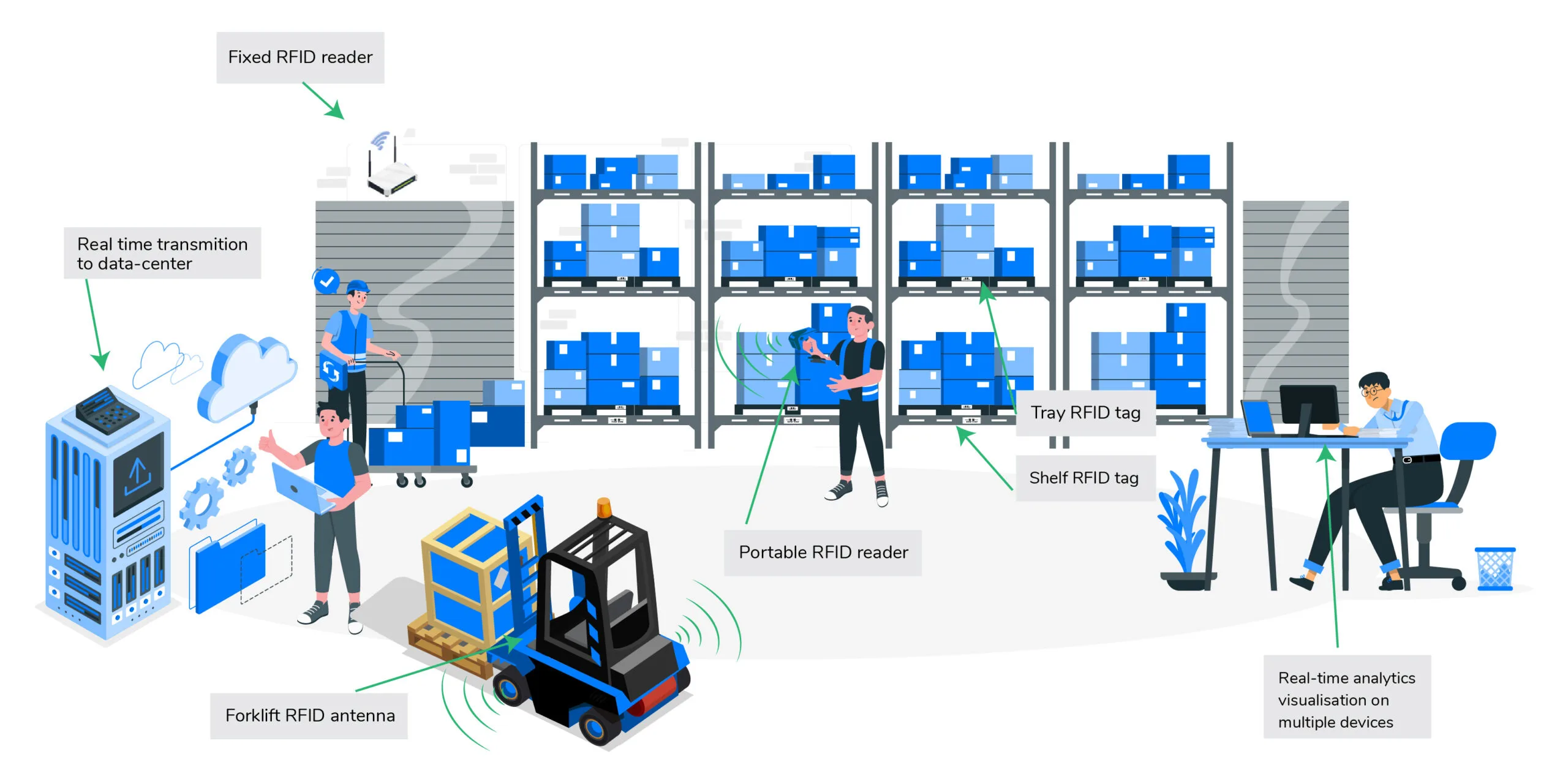
FIELD VIEW / WAREHOUSE EVENTS
Connect the zone
to the next action.
A warehouse RFID design links the physical handoff to the event the operating system needs to receive and review.
- Map receiving, staging and storage handoffs
- Connect readers, tags and event context
- Route confirmed reads to the warehouse system
02 / THE RFID WORKFLOW
Four moments.
One connected record.
Apply or print tags at receiving
Define the identity and the point where it enters the workflow.
Validate the read zone at dock or aisle
Capture a repeatable event with enough context to trust the result.
Capture bulk reads with handheld or fixed readers
Capture a repeatable event with enough context to trust the result.
Post confirmed events to the WMS
Route the confirmed event to the system and person who acts on it.
03 / OPERATING SCOPE
Start with the
event, not the device.
A useful solution brief makes the item, event, system handoff and evidence visible before a configuration is selected.
Inbound cartons, pallets, returnable units and staging locations moving through controlled warehouse handoffs.
Receipt, transfer, count, load or return event bounded by a dock, aisle, station or operator action.
A normalized movement event to WMS with location, direction, time and exception information.
A pilot that includes normal movements, nearby activity, mixed loads, failed reads and WMS recovery.
FIELD QUESTIONS
- Map the handoff before selecting a reader or portal layout.
- Use actual rack geometry, packaging and operator routes in the test.
- Separate incidental reads from the movement that should post to WMS.
- Freeze a configuration baseline before replicating it at another dock or site.
04 / WAREHOUSE EVENT REVIEW
Give each read
an accountable meaning.
A reader observation is only useful when the warehouse can decide what it means. Define the movement, expected state, exception owner and evidence for each handoff before treating a read as a WMS transaction.
Design the warehouse event before configuring the zone
| Operating moment | Business event rule | Exception path | Acceptance evidence |
|---|---|---|---|
| Receiving at the dock | A load-unit identity, dock location, intended direction and expected receipt state form a receipt candidate. | Route an unexpected, duplicate, partial or delayed observation to receiving review before inventory is updated. | Run normal inbound, staged-nearby, mixed-load and partial-pass samples; retain raw reads, normalized events, WMS responses and recovery actions. |
| Cycle count in an aisle | The count route, item or load-unit scope, location and review window define which observations belong to the count. | Keep an observed-versus-expected difference visible for recount, investigation and approved adjustment rather than treating it as an automatic stock change. | Test the normal route, dense storage, repeated scans and missing identity handling, then reconcile the result against the count record. |
| Load or dispatch verification | The assigned shipment, controlled lane, movement direction and time window determine when an observation becomes a load-verification candidate. | Hold unexpected, missing, late or reverse-flow identities for the shipment owner and preserve the physical observation for diagnosis. | Exercise correct and incorrect loads, adjacent staging, reversals and retry behavior; confirm the final shipment state and operator recovery path. |
INDUSTRY CONTEXTS
Apply the workflow
to the operating setting.
These published industry routes apply the same solution pattern to a specific operating context. They are starting points for review, not a statement that any reader category or profile is ready for every environment.
05 / THE SYSTEM
Build around
the point of work.
Start with the read event and its purpose. Then select the tag, reader, antenna and software that support that event in the real environment.
Rugged UHF handhelds
Specified around the item, environment and operating step.
Fixed reader and directional antennas
Specified around the item, environment and operating step.
On-metal or general-purpose labels
Specified around the item, environment and operating step.
Edge middleware or API connector
Specified around the item, environment and operating step.
06 / SOFTWARE & INTERFACES
Make the read
mean something.
Supports WMS receiving, inventory adjustment, location transfer and exception workflows through REST, webhooks or an integration service.
Learn more07 / TEST METHOD
Measure the
uncertainty.
We establish a baseline with your real carton mix, rack geometry, tag orientation and target throughput rather than relying on open-air range figures.
- Representative materials and item mix
- Read range, speed and false-read checks
- Operator workflow and exception path
08 / DEPLOYMENT
Start with
one proven zone.
Map read zones, configure power and session settings, pilot one process and publish an operator playbook before site-wide deployment.
09 / WHAT GOOD LOOKS LIKE
Evidence your
team can use.
More dependable warehouse visibility with a rollout plan built around measured read behavior and the customer system of record.
Yêu cầu báo giá10 / FAQ
Questions worth
asking early.
Metal racks can create reflections and read zones that are too broad. Antenna direction, power, tag choice and pilot testing are all part of the design.
Yes. We document the site profile, configuration baseline, training checklist and acceptance test so a proven design can be replicated.
RFIDBRIDGE / NEXT STEP
Ready to test
the real thing?
Bring a representative item, a read target and the system that should receive the event.
Yêu cầu mẫu